Applied-Field Magnetoplasmadynamic Thruster

Open AF-MPD Thruster

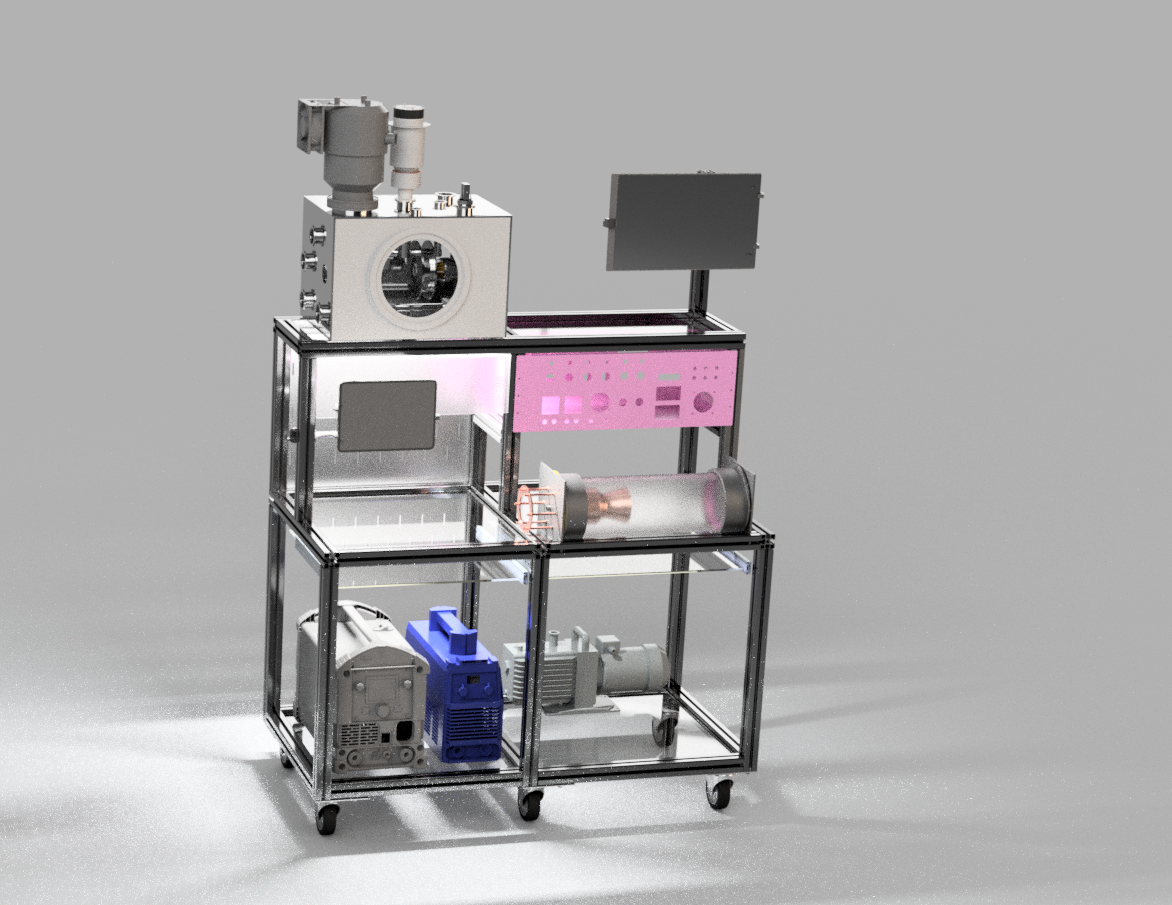
Use the setup overview on the right as your main homepage image. Hover the labels to highlight each subsystem and show a short explanation, so you can introduce the full experimental platform quickly.

Editable folder: media-library/ Images: media-library/images/ Videos: media-library/videos/
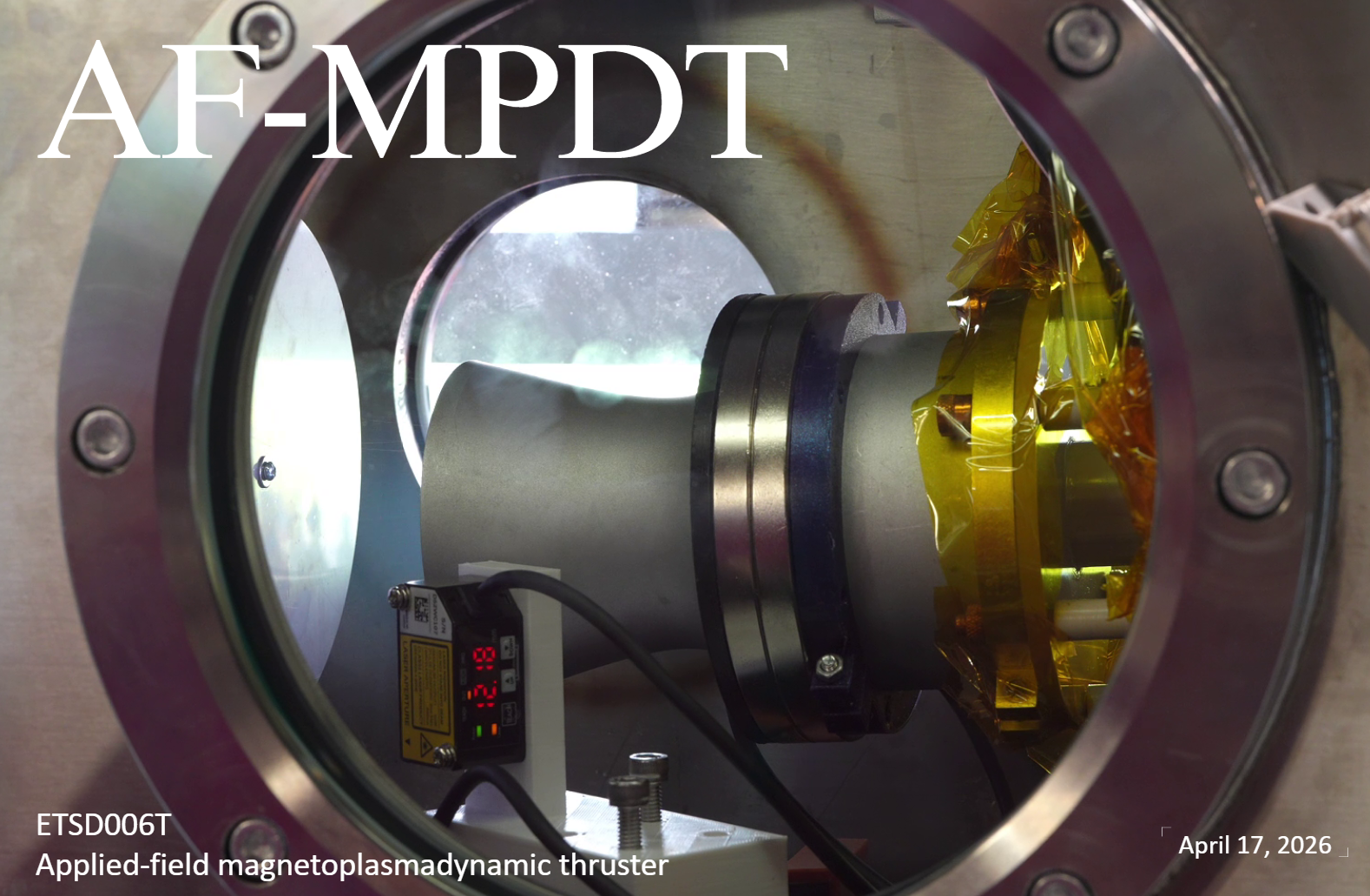
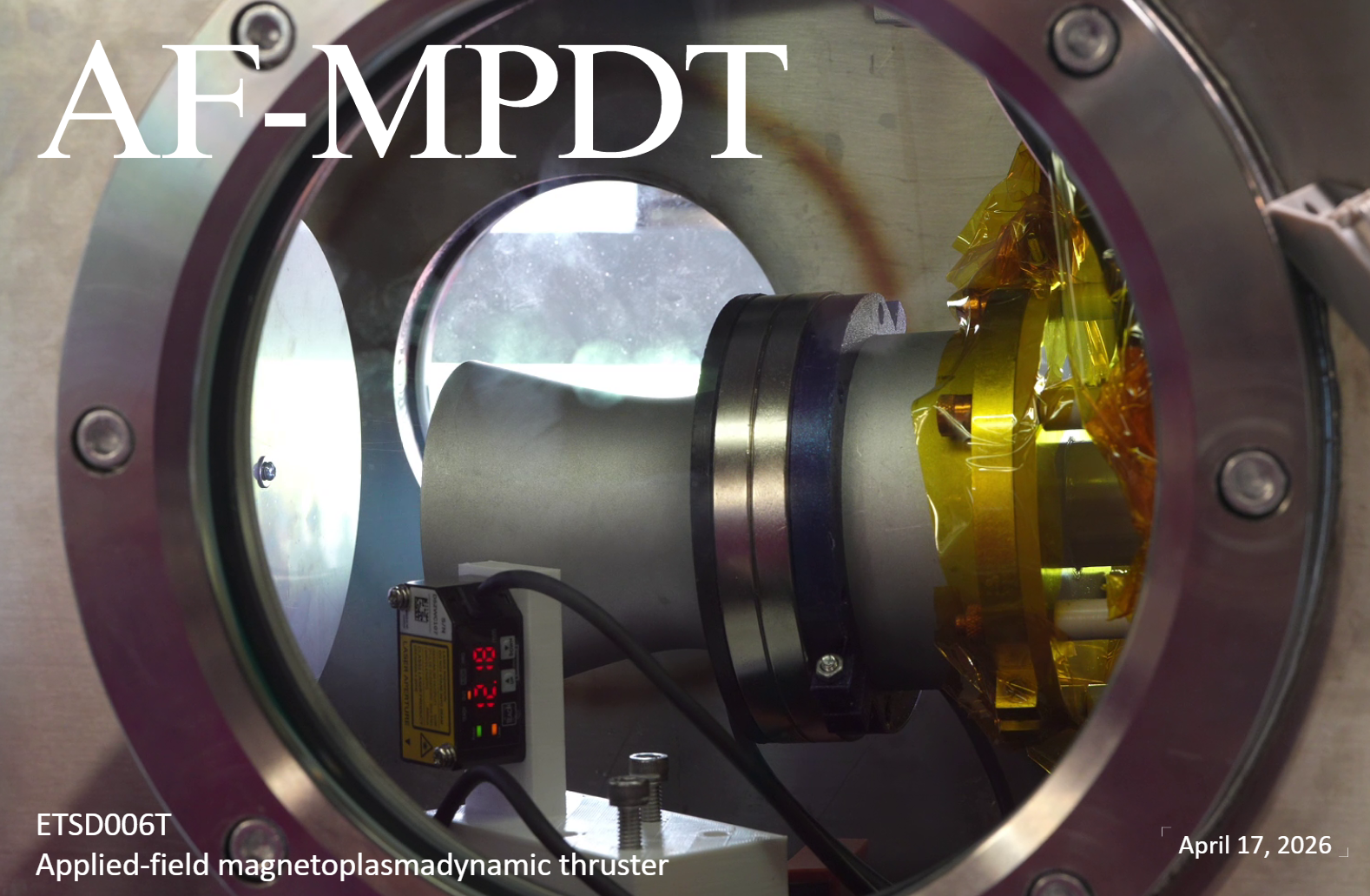
Custom AF-MPDT hero image
Setup overview Replace this image from the media library Upload your overview image, then edit the label positions and descriptions in homepage-config.js.

Project Overview

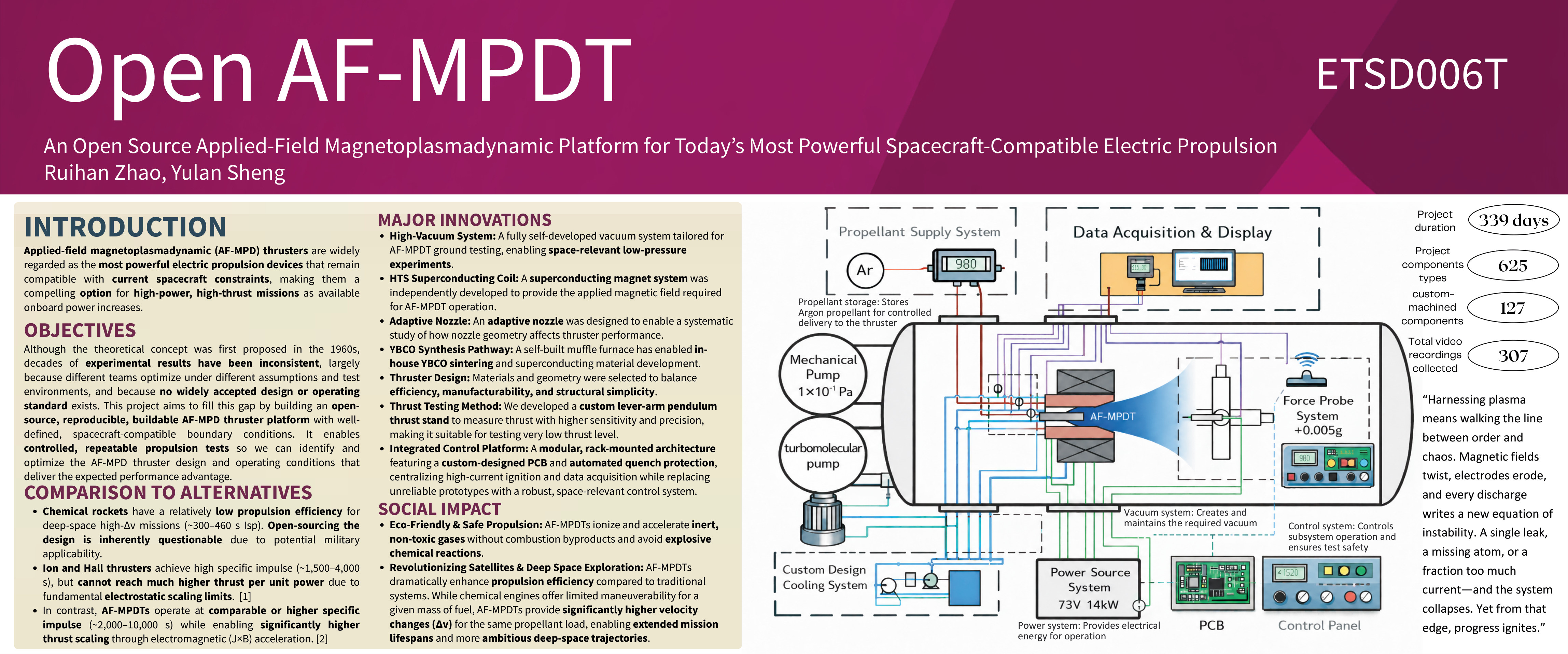
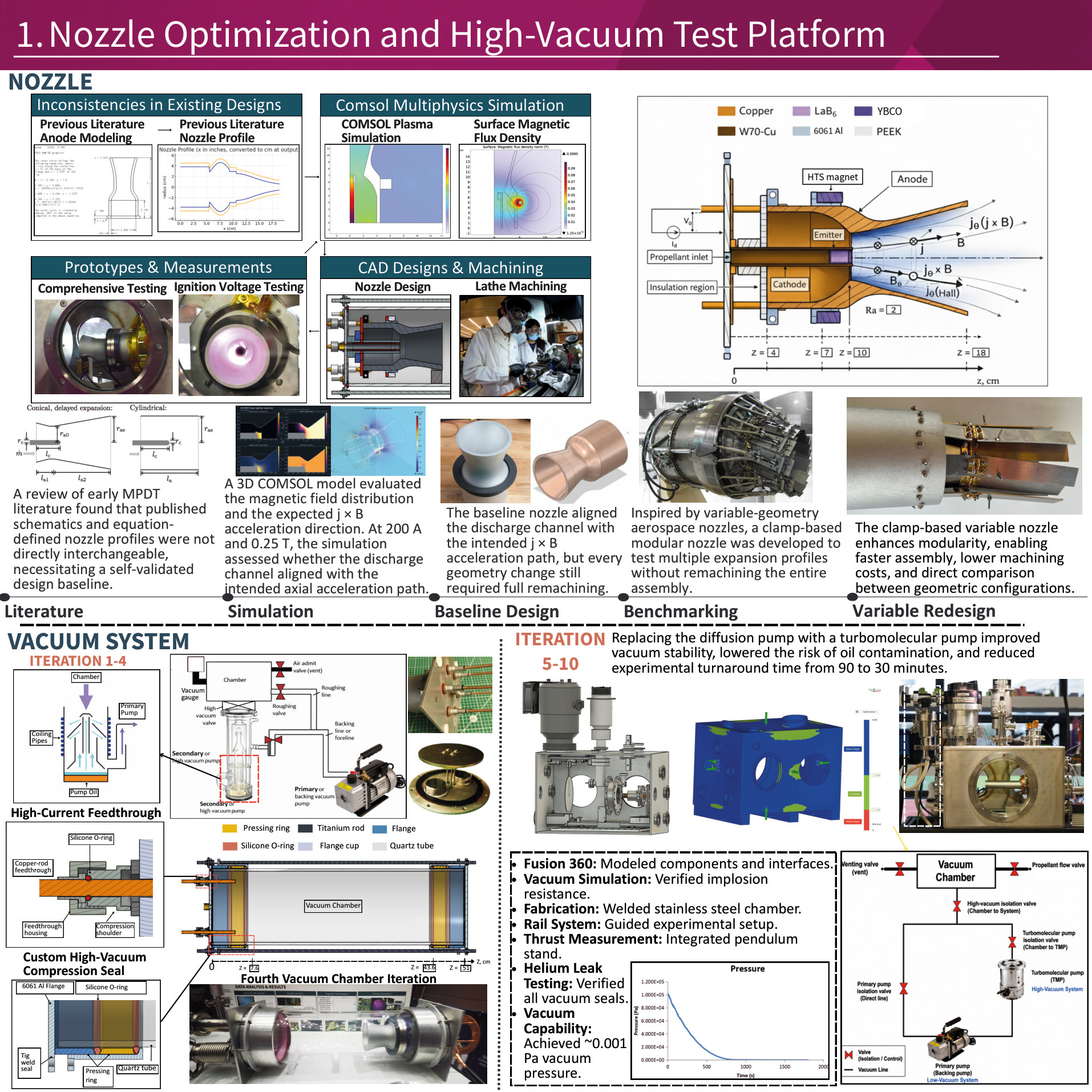
AF-MPDT is a high-power electric propulsion effort focused on controllable plasma acceleration under an externally applied magnetic field. The platform is not a conceptual mock-up; it integrates a manufacturable thruster core, power delivery, superconducting field generation, vacuum qualification, and diagnostics into one reproducible experimental stack. Compared with chemical propulsion, performance is driven by electromagnetic energy transfer and current-path stability rather than combustion energetics, making geometry-field coupling the dominant engineering variable.

Thruster

Discharge channel and plume acceleration core.

Defines current closure and plasma momentum coupling. Stability depends on geometry and magnetic interaction.

Anode Geometry

Attachment and acceleration region control.

Controls current attachment and acceleration zone. Strongly affects efficiency and discharge stability during scaling.

Cathode

Electron emission and arc sustainment.

Sets emission consistency and discharge startup reliability. Material and thermal loading are key constraints.

Magnetic Field System

Applied-field confinement and acceleration.

External field shapes current paths and plume expansion. Enables controlled Lorentz-force dominated operation.

Vacuum System

Pressure regime and contamination control.

Maintains plasma-relevant pressure and clean flow conditions. Pump staging controls repeatability and noise floor.

Power Electronics

17 kW-class delivery and transient handling.

Provides stable high-current operation with monitored transients. Electrical dynamics directly influence discharge behavior.

Diagnostics

Measurement of force, plasma, and electrical states.

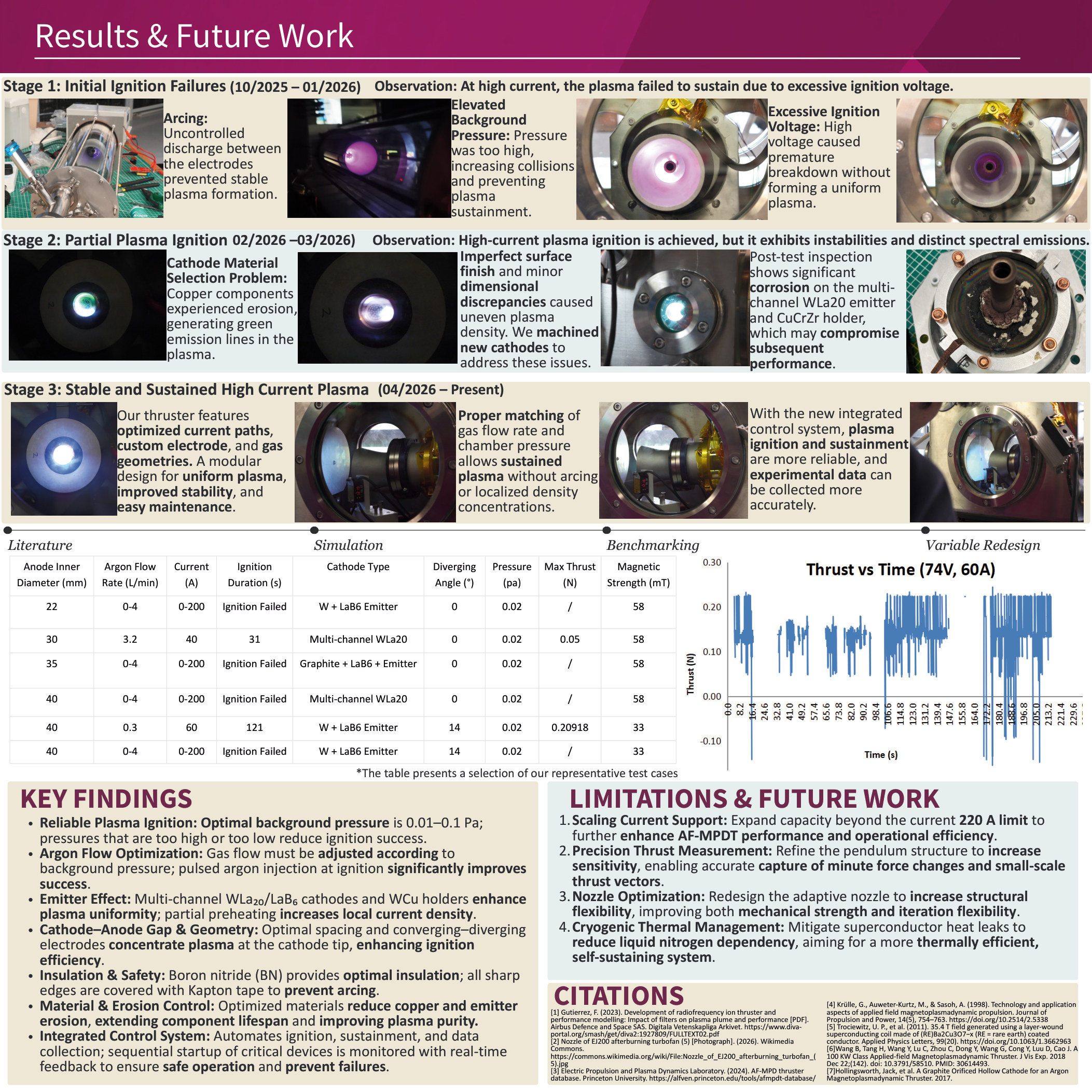
Converts tests into engineering evidence. Includes thrust, I-V, probe, and pressure channels with synchronized acquisition.

Open Source Platform

CAD, PCB, code, test protocols.

Reproducibility layer for students and researchers. Hardware, software, and procedures are documented as transferable modules.

Custom Media Library

All manually editable homepage media now lives in the separate media-library folder. Replace images or videos there, then refresh the page to update the homepage.

Manual Workflow

  1. Put homepage images into media-library/images/.
  2. Edit homepage-config.js to change the hero image path, label positions, and label descriptions.
  3. Put videos into media-library/videos/.
  4. After replacing a file with the same name, press Ctrl + F5 to refresh without cache.
Add your video file to media-library/videos/ and set the filename in homepage-config.js.

Project Video

The player uses poster-first display, metadata preload, and lazy source loading to keep the page fast.

Fast Load Setup

  1. Use .mp4 (H.264) or .webm for good browser compatibility.
  2. Keep a lightweight poster image in media-library/images/ so the page looks complete before playback.
  3. Compress long videos before uploading to reduce first-play delay.

Interactive System Architecture

Hover any node for concise context. Click nodes to open engineering-level details, including status, materials, parameters, and next actions.

Thruster Core

Discharge assembly

Includes anode-cathode pair, discharge region, and plume exit plane.

Applied Magnetic Field

Field-coupled acceleration

External B-field reconfigures current path and momentum transfer profile.

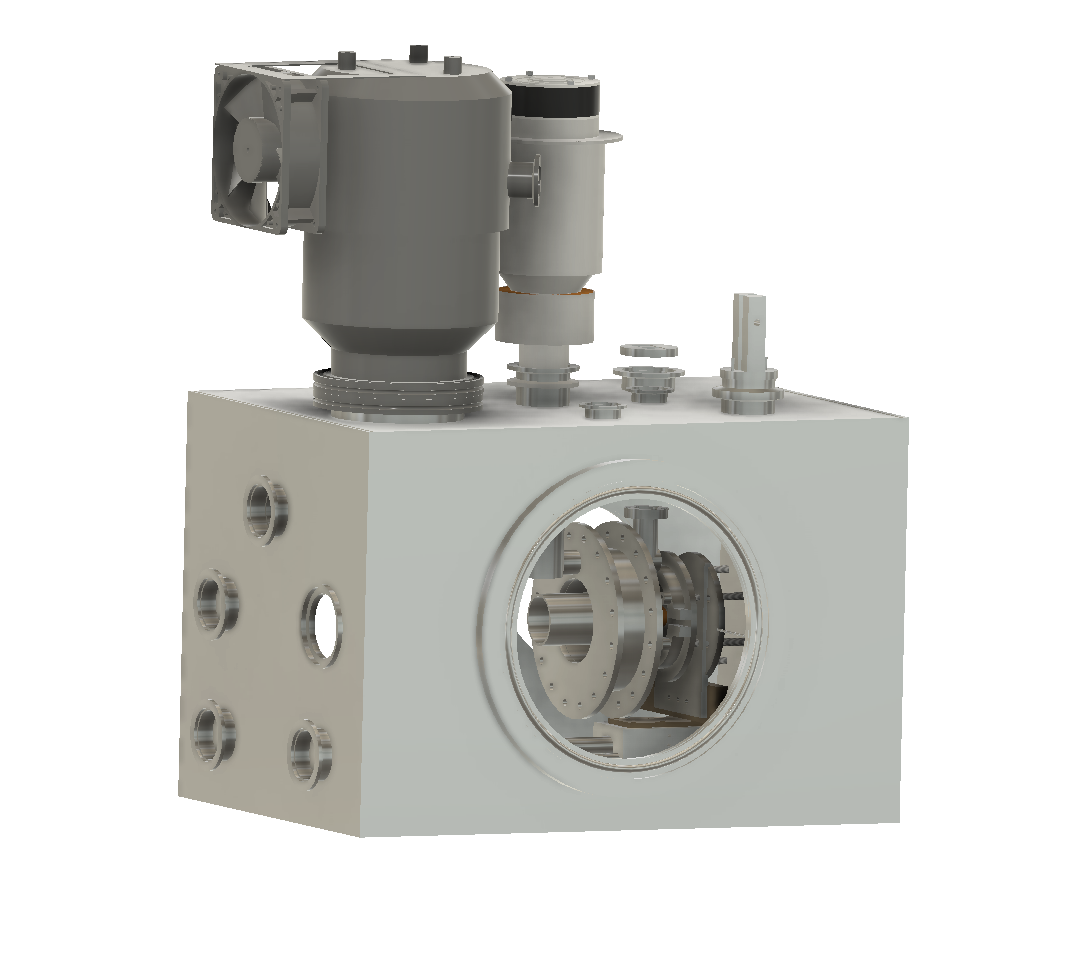
Vacuum Chamber

Plasma test environment

Low-pressure enclosure with feedthroughs, thermal shielding, and optical access.

Anode Geometry

Attachment profile

Geometry tuning is central for stable high-power operation and efficiency.

YBCO Coil

Double pancake stack

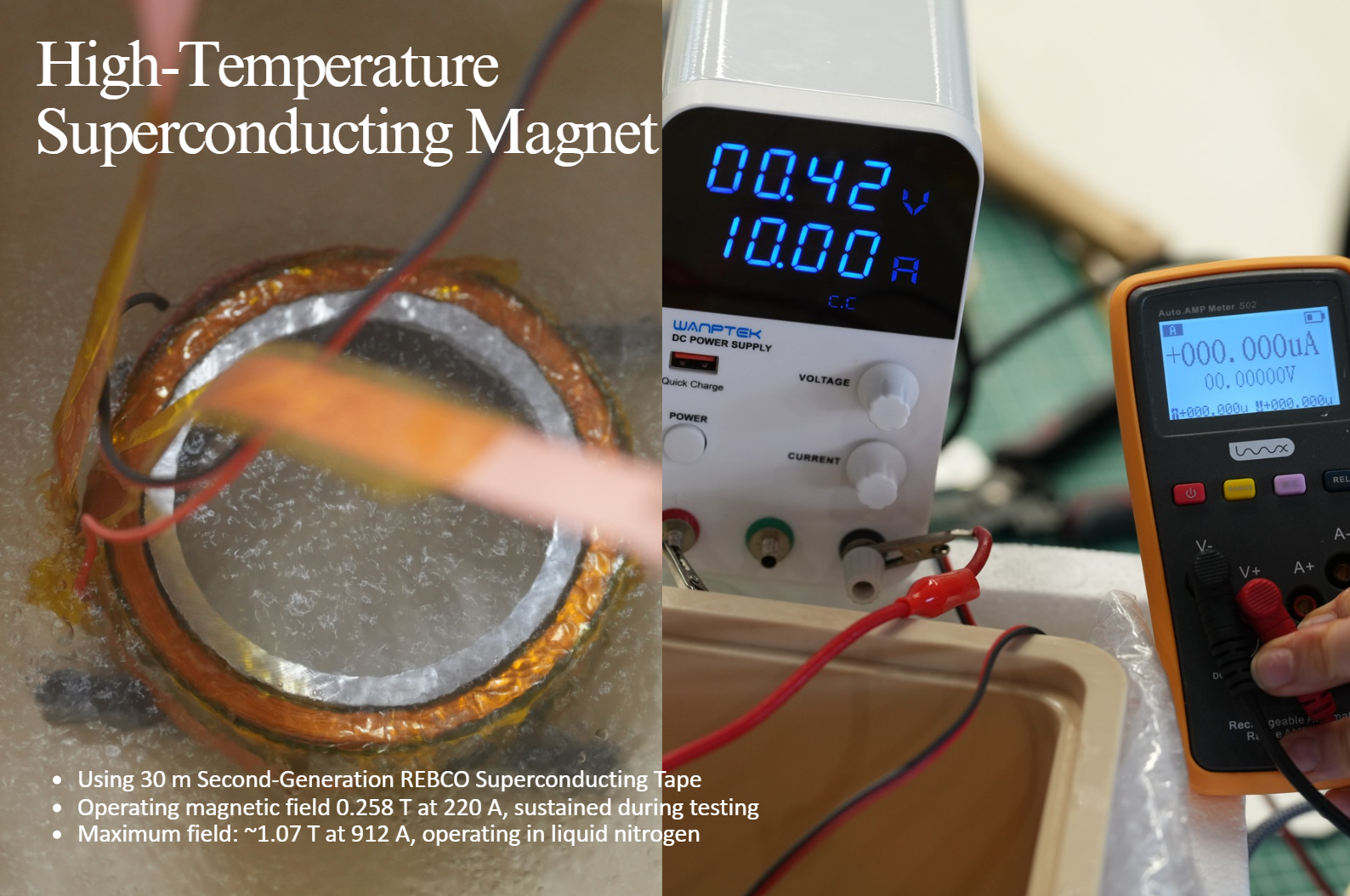
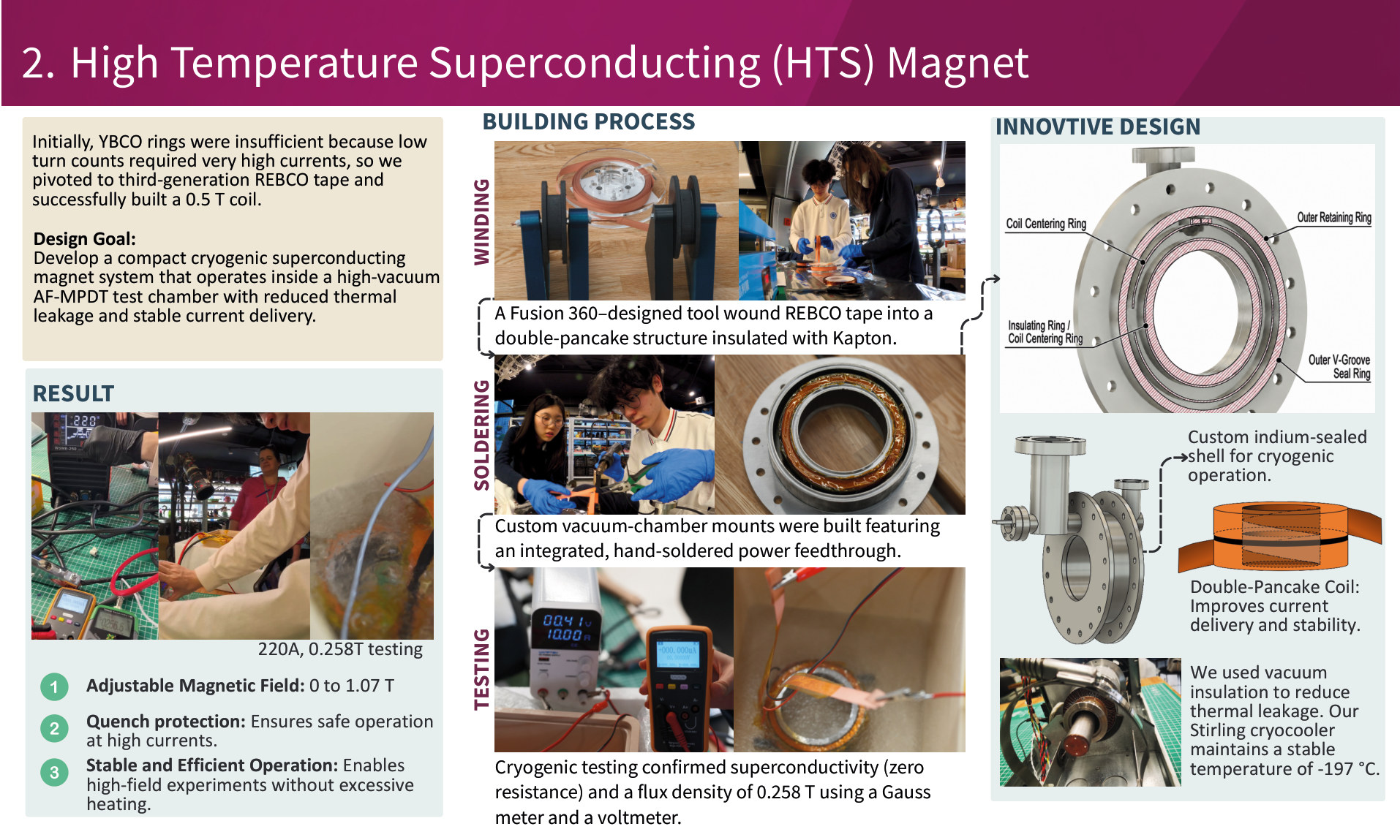
Superconducting coil target: high current density with LN2 thermal margin.

Pump Chain

Backing + high-vac stage

Mechanical + diffusion/turbo stages set pressure floor and gas handling dynamics.

Cathode System

Emission stability

Electron source reliability controls ignition margin and arc persistence.

Power Delivery

17 kW pulse/DC control

Conditioning and protection network for high-current transients and diagnostics isolation.

Control & Data Acquisition

ESP32 + Jetson pipeline

Synchronized capture for thrust, I-V, probe, and chamber channels.

Thruster Core Section

Current Path Cathode Discharge Region Anode Plasma Plume

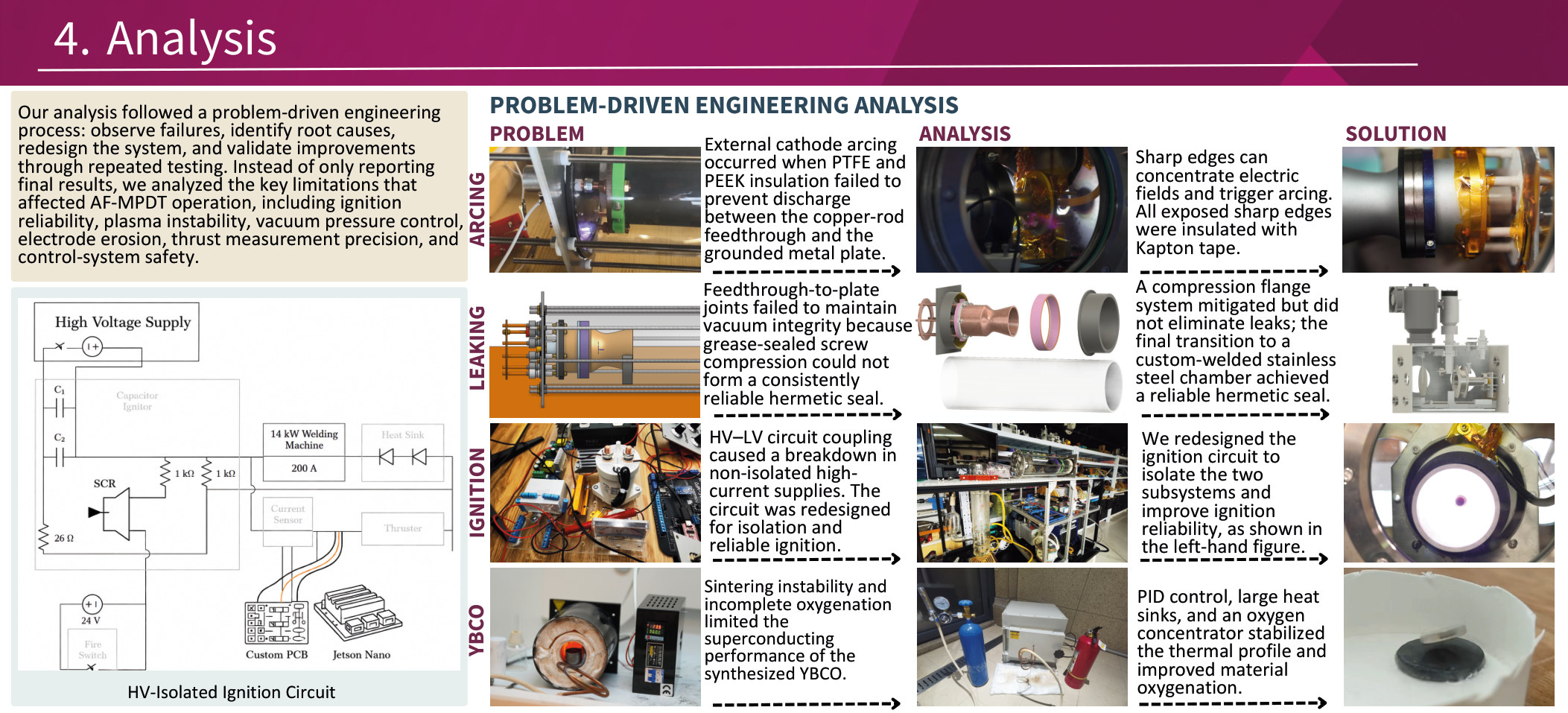
The thruster module resolves current attachment, ionization, Lorentz-force acceleration (J × B), and plume divergence as one coupled problem. Current anode iterations prioritize robust attachment and reduced discharge oscillation at higher power.

Anode

Primary geometry optimization target.

Focus: attachment control, thermal flux distribution, and erosion-sensitive surfaces.

Cathode

Emission and startup reliability.

Emission consistency is critical for ignition repeatability and steady arc operation.

Discharge Channel

Electromagnetic acceleration domain.

Defines where plasma momentum rises; geometry and field jointly shape plume quality.

Magnetic Field Section

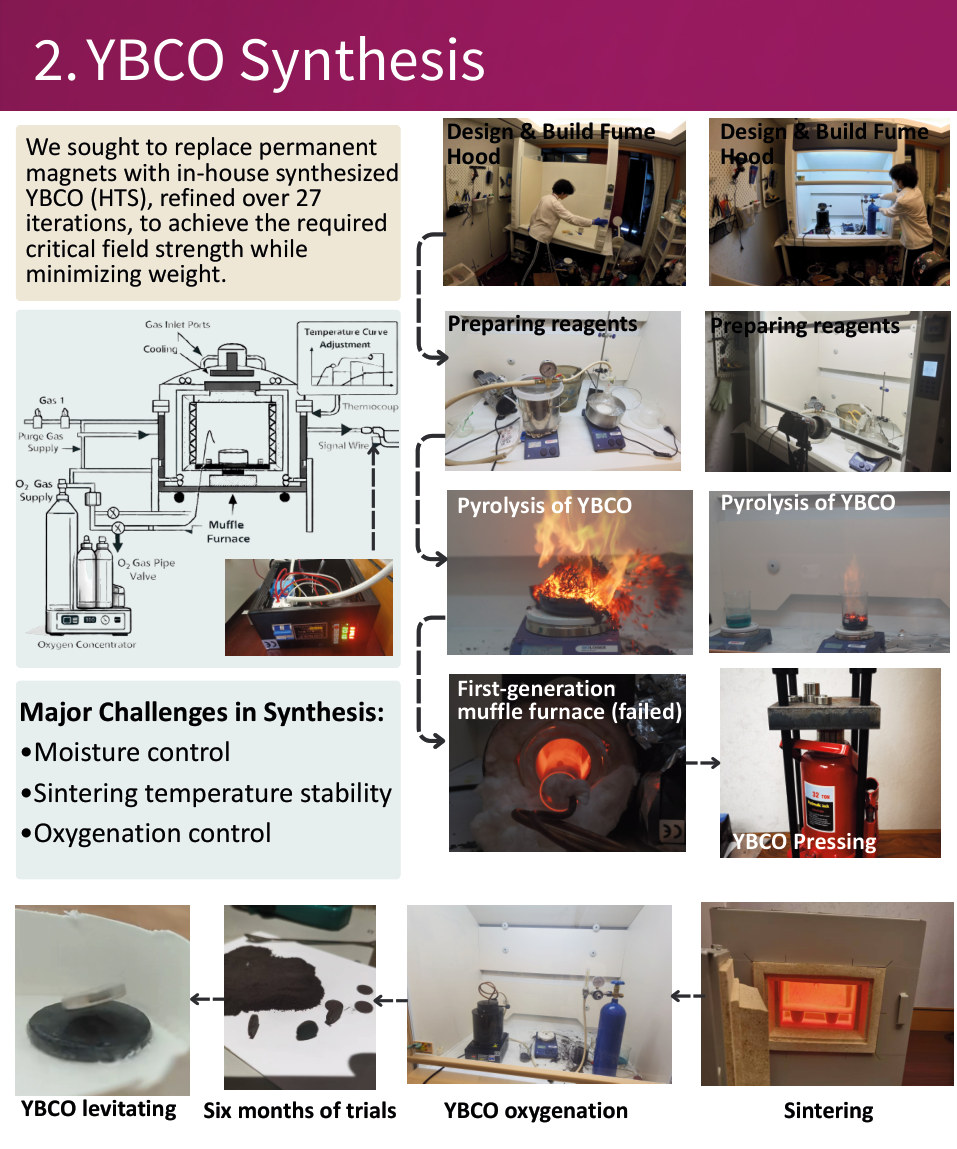
Applied-field operation uses YBCO/REBCO superconducting coils in a double-pancake structure with LN2 cooling. Field strength is tuned to improve confinement, reduce radial loss, and increase effective electromagnetic acceleration length.

YBCO / REBCO Coil

High-current superconducting architecture.

Double-pancake winding with thermal and quench margin consideration.

Field Control

Target current and B-field sweep plan.

Maps discharge stability versus applied field across operating points.

LN2 Thermal Loop

Cryogenic support subsystem.

Supports superconducting state retention and repeatable test duty cycle.

Vacuum Platform Section

The vacuum stack combines mechanical backing with high-vacuum stages (diffusion or turbo), chamber conductance management, and leak-sensitive sealing strategy. Pressure regime control is required for interpretable plasma diagnostics and repeatable thruster signatures.

Mechanical Backing Pump

Roughing and throughput baseline.

Defines gas load preconditioning before high-vacuum stage engagement.

Diffusion/Turbo Stage

Low-pressure regime achievement.

Controls ultimate pressure and affects contamination and oil-backstreaming risk strategy.

Chamber & Feedthroughs

Structural and electrical interface layer.

Material, seal, and thermal decisions directly affect leak rate and reliability.

Experimental Diagnostics

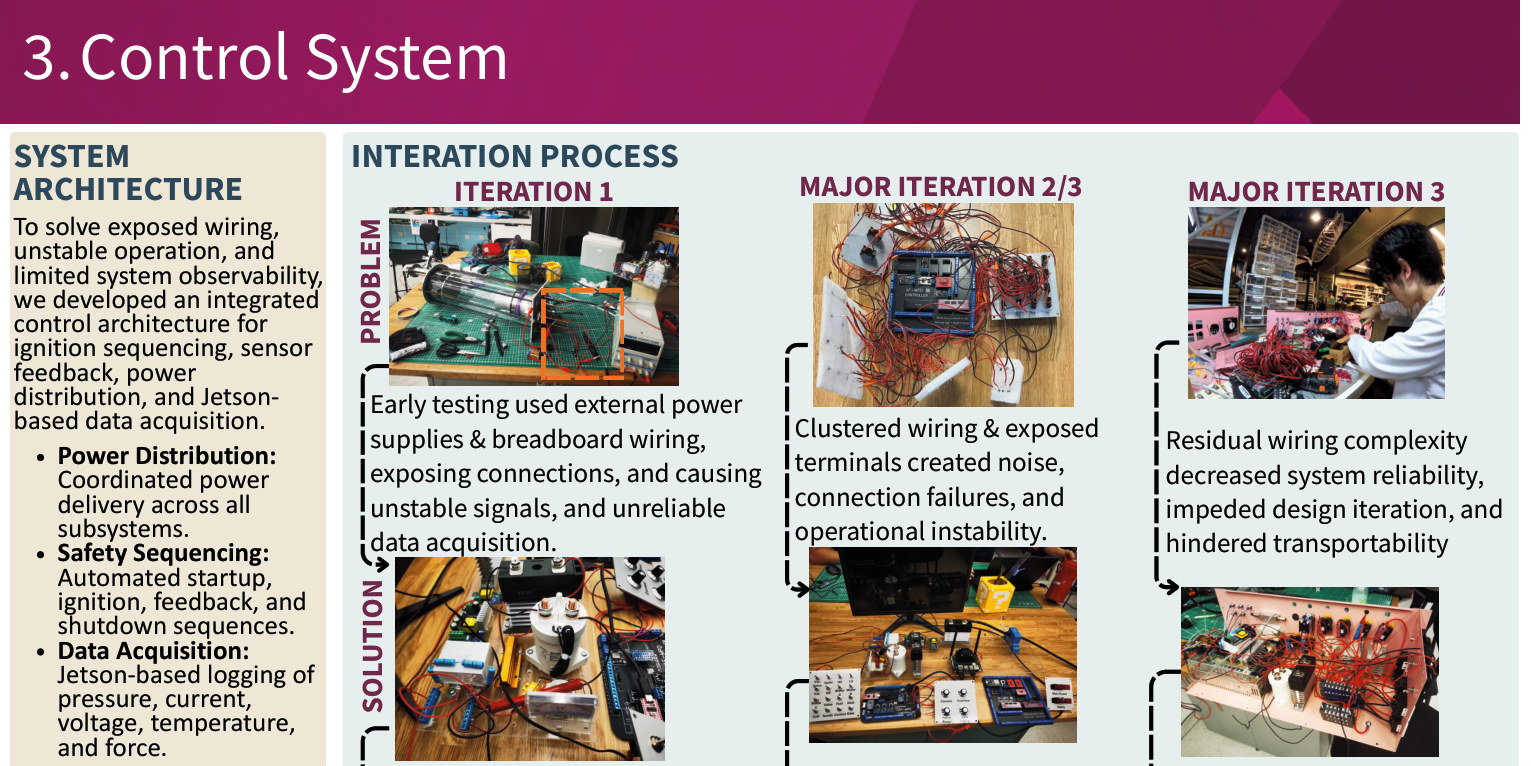
Instrumentation spans thrust measurement, current/voltage waveforms, Langmuir probe plasma characterization, and pressure sensing. DAQ is implemented with ESP32 edge capture and Jetson aggregation for synchronized analysis pipelines.

Thrust Measurement

Force stand and drift compensation.

Transforms plume behavior into quantitative performance metrics.

I/V Monitoring

High-bandwidth electrical channels.

Captures transient discharge dynamics tied to stability windows.

Langmuir Probe

Density and temperature estimation.

Enables plume diagnostics and operating-point comparison.

ESP32 / Jetson DAQ

Acquisition and experiment logging.

Supports multi-channel synchronization and reproducible test records.

Open Source & Reproducibility

CAD

Manufacturable geometry packages.

Versioned assemblies for thruster, chamber interfaces, and fixtures.

PCB / Electronics

Power and instrumentation boards.

Schematics, board files, and bring-up notes with revision tracking.

Control Code

DAQ firmware and analysis scripts.

Enables repeatable test procedures and data reduction pipelines.

Documentation

Protocols and experiment logs.

Turns isolated tests into transferable research workflows.

Vision

The long-term objective is to make advanced propulsion experimentation accessible to student-led and research-lab teams without sacrificing engineering rigor. AF-MPDT is positioned as a shared infrastructure initiative: beyond chemical propulsion constraints, toward repeatable deep-space hardware development workflows.

Contact & Collaboration

Research collaboration: research@af-mpdt.org

Engineering discussion: engineering@af-mpdt.org

Open-source contribution: github.com/af-mpdt

Academic outreach: outreach@af-mpdt.org